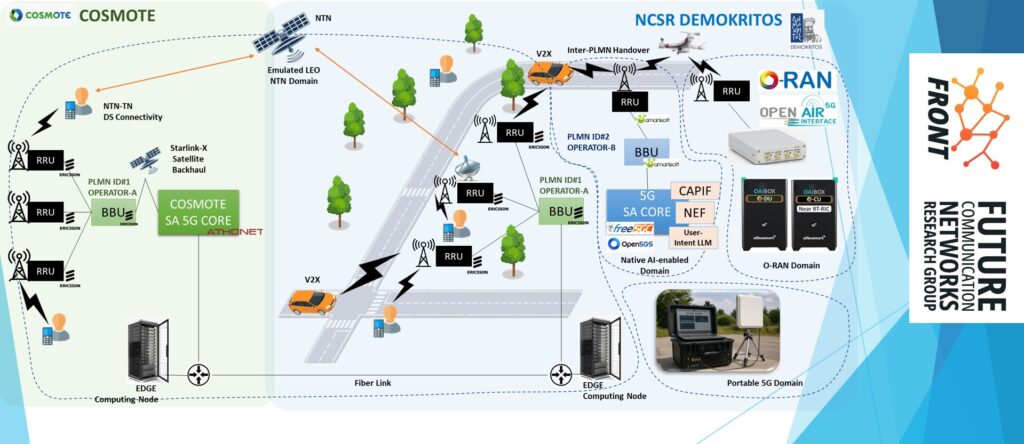
While service deployment is fully automated and transparent through the aerOS orchestration framework, a comprehensive set of 5G and Non-Terrestrial Network (NTN) technologies forms the backbone of the platform’s advanced networking capabilities. The platform hosts two distinct 5G Standalone (SA) networks:
- The first network, based on ATH 5G SA Core and Ericsson equipment, spans both campuses. The ATH 5G Core, deployed at the OTE Academy, controls two Ericsson BBUs (at OTE and NCSR campuses), each supporting three Ericsson RRU/RAN units, creating a large-scale experimental 5G network with six indoor/outdoor cells in total. OTE also deploys mmWave RAN equipment to enhance experimental capabilities.
- The second network, deployed at NCSR Demokritos, leverages Amarisoft 5G RAN with flexible 5G SA Core options, including Amarisoft and Open5GS. These cores offer varying levels of openness (e.g., NEF, NWDAF, CAPIF) and native AI programmability. The platform also integrates software RAN solutions like UERANSIM (monolithic and containerized) and srsRAN (gNB and UE via ZeroMQ).
In addition to these large-scale infrastructures, the platform also includes:
- An OpenAirInterface (OAI) OAIBOX, which integrates a complete 5G Core with Split 8 architecture, enabling flexible, open-source experimentation. The OAIBOX serves as a versatile testbed for RAN and core network integration in research scenarios.
- A portable 5G system based on Raspberry Pi that features a containerized 5G Core for lightweight, flexible deployments. This compact solution enables rapid setup of portable 5G networks while allowing integration with a variety of external or separate RAN units, depending on the testing scenario or deployment requirements. It is particularly suited for experiments in constrained, temporary, or remote environments.
The convergence of the aerOS continuum with B5G networking is a key innovation of the Athens platform. Containerized 5G network functions (NFs), such as Open5GS UPF, benefit from aerOS’s orchestration, allowing dynamic deployment and migration based on application-specific or user-centric policies.
The platform also provides extensive RAN and data monitoring capabilities:
- Amarisoft 5G RAN offers flexible configurations for sub-6 GHz bands, supporting bandwidths up to 50 MHz, multiple subcarrier spacings, and MIMO up to 4×4.
- OAI OAIBOX RAN implements a flexible, open-source 5G RAN architecture based on 3GPP standards, supporting Split 8 functional split for integration with external components. It supports both NSA and SA modes, operates in sub-6 GHz bands with up to 100 MHz bandwidth, 2×2 MIMO, and provides 250 mW (24 dBm) per port output power with up to 32 simultaneous connections. The OAIBOX allows fine-grained protocol stack configuration, making it highly suitable for research-driven, experimental scenarios.
- Data Collection & Monitoring: A monitoring framework based on Prometheus includes a main server with a time-series database, an alert manager for alarms, Node Exporters for resource metrics, and Grafana for real-time visualization.
Innovative Infrastructure
Implemented state-of-the-art network infrastructure for advanced B5G and 6G experimentation.
Collaborative Partnerships
Established collaborations with leading universities and tech companies to enhance research capabilities.
Cutting-Edge Technologies
Developed pioneering technologies that set new benchmarks in the telecommunications industry.
Open Access Framework
Launched an open access framework to encourage wider participation in B5G/6G research.